


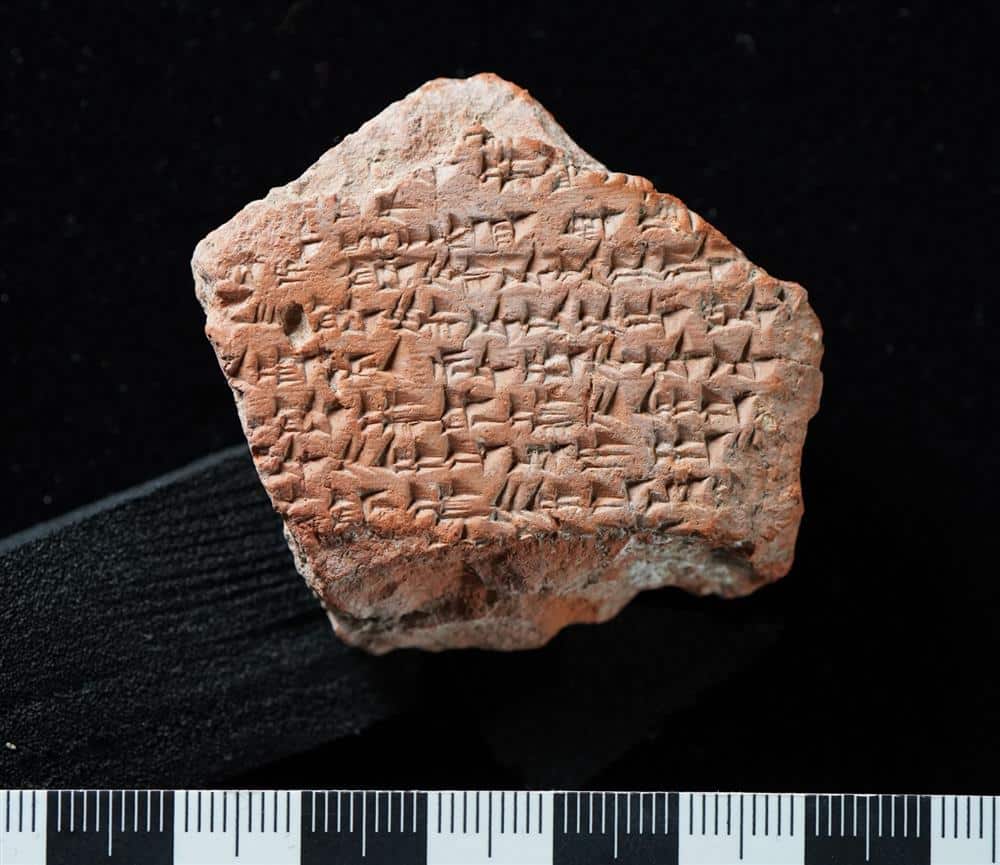
The Turkish Ministry of Culture and Tourism recently announced the discovery of a cuneiform tablet fragment recording the Treaty of Kadesh, signed in approximately 1269 BC by Pharaoh Ramesses II and the Hittite king Hattusili III. The text on the fragment outlines provisions for people seeking refuge from one country to another. While other copies of the treaty have been discovered elsewhere, archaeologists found this tablet fragment while excavating a building in the Hittite capital of Hattusa.
The Hittites established a powerful kingdom in Anatolia that flourished during the Late Bronze Age (ca. 1650–1200 BC). While Ramesses II is not explicitly named in the Bible, the Hittites are. However, there is confusion surrounding two seemingly distinct groups of “Hittites” in the Bible: those from Anatolia and those native to Canaan. Research by ABR’s Dr. Bryant Wood (see link below) suggests that the majority of the Hebrew terms for “Hittites” (the singular forms) should be translated “Hethites”—the indigenous descendants of Heth, the son of Canaan (Gen. 10:15)—while a small number (six plural forms) refer to the Hittites of Anatolia (modern Turkey). This solution, based on linguistic and archaeological evidence, challenges the claims of critics who argue that the biblical references to the Hittites are anachronistic or historically inaccurate.
Source: https://basin.ktb.gov.tr/TR-474337/barisin-binlerce-yillik-izi-hattusada-gun-yuzune-cikti.html
Bryant Wood’s article on Hittites: https://biblearchaeology.org/research-articles/hittites-and-hethites-a-proposed-solution-to-an-etymological-conundrum/
Read more BREAKING NEWS articles here: https://biblearchaeology.org/category/breaking-news/